






By Zhao Huanxin in Washington
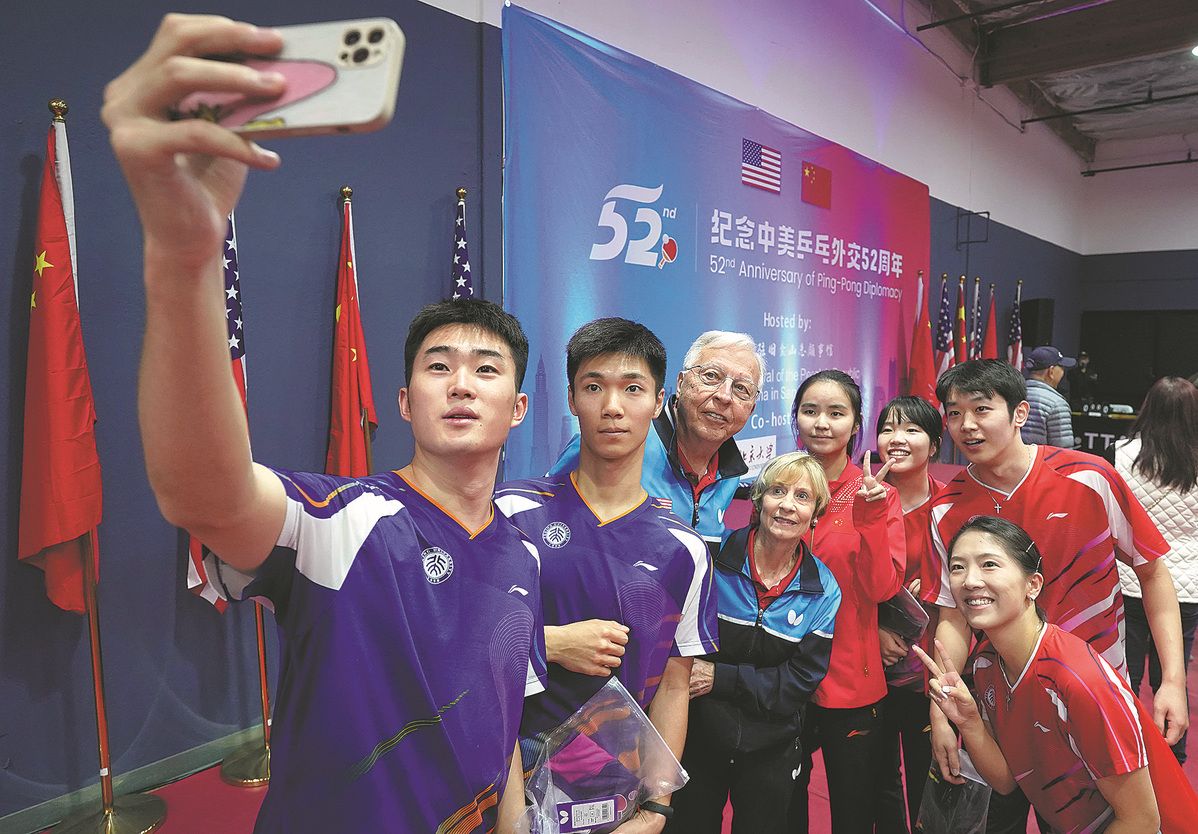
Players of Peking University's table tennis team pose for a group photo on Friday with Dell and Connie Sweeris, who were part of the team from the United States that visited China in 1971, in San Francisco, California, in the US. [LIU GUAN GUAN/CHINA NEWS SERVICE]
When Connie Sweeris, then reigning United States national table tennis champion, traveled to China in 1971 on a historic trip that marked the start of Ping-Pong Diplomacy between the two nations, Xie Feng was just a boy of around 7 years old.
Now, 52 years later, Xie, Chinese ambassador to the US, played against Sweeris at the embassy in Washington, in a "game" that drew applause from a hall of spectators.
Their "face-off" was followed by friendly matches between the visiting Peking University table tennis team and US players on Wednesday to mark the 52nd anniversary of Ping-Pong Diplomacy, which set in motion a thaw in relations between the two countries that had remained chilly since 1949.
Commemoration events, including friendly matches, were also held in San Francisco on Thursday and Friday.
"My hope is that the younger generation today that play table tennis will carry the Ping-Pong Diplomacy legacy forward, and that even though we have a lot of differences, maybe ideologically, we can be friends, we don't have to be enemies," Sweeris said.
Xie agreed. In a speech that followed the match, the envoy talked about the spirit of sportsmanship. "One cannot be both the judge and the athlete, tie the hands of their competitors, still less deny others an opportunity to be part of the game," he said, alluding to the fact that the US has been dominantly featuring competition in bilateral relations.
Playing sports is about embracing openness and inclusiveness, and rising above differences. "There is no reason why competitors cannot also be friends," he said.
Xie shared an anecdote about Sweeris. On her passport, China was originally listed among the countries it was not valid for traveling to, but US officials took a black marker and crossed out "China" to make the visit possible, he said.
The passport, which was donated by Sweeris to the National Museum of American Diplomacy in Washington, underlines that the seemingly simple cross-off was an act of decisiveness and creativity in line with the trend of the times that remains indispensable today, Xie said.
As the China-US relationship is again at a crossroads, the era is calling for drawing wisdom and strength from Ping-Pong Diplomacy, stabilizing and improving the relationship, and ensuring its sound, stable and sustainable development, he said.
"Since China and the US managed to break the 22-year-long ice 52 years ago, we should have even greater confidence today to shake off the Cold War mentality, defy the political correctness, and leap across the trap of major-country conflict," he said.
Jan Berris, vice-president of the National Committee on US-China Relations, who received the Chinese table tennis team in a reciprocal visit to the US in 1972, said she had been involved in thousands of exchanges between the two countries following those first two exchanges in the early 1970s.
"Once we had a chance to meet, to talk, to share experiences, to compete, to get to know one another, we found that, actually, we had many things in common," she said. "Despite our political differences, and many of our social values, we actually could get along quite well with one another."
Dragomir Cioroslan, director of international strategies and development at the US Olympic&Paralympic Committee, said the first exchanges between table tennis players of the two countries was a "groundbreaking" event that marked the start of a new era, characterized by dialogue, cooperation and mutual respect.
Copyright © 2001-2025 湖北荆楚网络科技股份有限公司 All Rights Reserved
互联网新闻信息许可证 4212025003 -
增值电信业务经营许可证 鄂B2-20231273 -
广播电视节目制作经营许可证(鄂)字第00011号
信息网络传播视听节目许可证 1706144 -
互联网出版许可证 (鄂)字3号 -
营业执照
鄂ICP备 13000573号-1  鄂公网安备 42010602000206号
版权为 荆楚网 www.cnhubei.com 所有 未经同意不得复制或镜像