






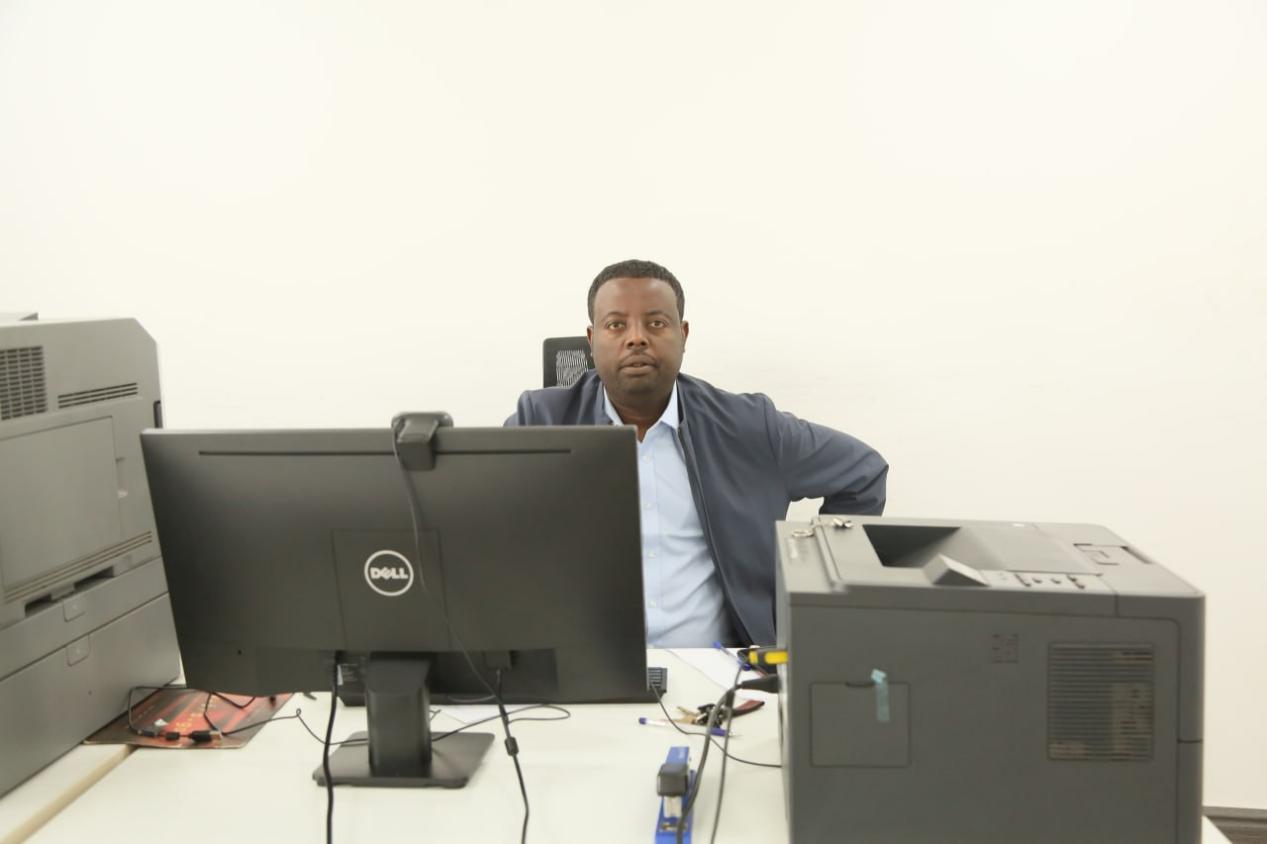
Photo provided to Guangming Online
In an exclusive interview with Guangming Online, Dr. Balew Demissie, Communication and Publication Consultant at the Policy Studies Institute, Ethiopia’s government think tank, expressed his belief that Africa and China, with their shared histories and similar development trajectories, are destined to continue growing together. He emphasized that both regions face common challenges and require common solutions, underscoring the need for collaboration across various sectors, including academia and research.
Dr. Demissie pointed to one of the key initiatives that exemplify this commitment: a letter sent to President Xi Jinping with the aim of fostering stronger academic cooperation and research, particularly in the area of China-Africa relations. He explained, “Our primary goal is to achieve mutual growth, development, and progress by investing in human capital and enhancing research capabilities.” This initiative was warmly received by President Xi, who responded with encouragement, urging collaboration in three major areas: Africa-China relations, the Global South, and South-South cooperation. This endorsement has spurred continued efforts by African intellectuals and leaders to work together in these domains.
Shifting to a more specific example of Africa-China collaboration, Dr. Demissie discussed the evolution of Ethiopia-China relations. While the diplomatic ties between the two countries began in the 1970s with a focus on political matters, the relationship has transformed significantly over the years. The shift towards economic cooperation has been particularly marked since the late 1990s. Notably, China’s involvement in Ethiopia’s infrastructure development has been substantial, with one of the most significant projects being the Addis Ababa-Djibutie Railway. This crucial infrastructure, part of China’s Belt and Road Initiative, now facilitates 95% of Ethiopia’s imports and exports and has become the backbone of the nation’s economy.
Beyond infrastructure, China has contributed to Ethiopia’s telecommunications sector and played a key role in educating Ethiopian students. “Many Ethiopian students are now pursuing advanced degrees in China, a testament to the growing academic exchanges between our two countries,” Dr. Demissie noted. This development is complemented by ongoing efforts to build deeper cultural ties, such as Chinese cultural troupes visiting Ethiopia and Chinese restaurants opening in the country. The establishment of institutions like the Confucius Institute in Ethiopia, where Chinese language and culture are taught, further solidifies the bond between the two nations.
Dr. Demissie also highlighted China’s extensive technical and medical assistance to Ethiopia, particularly through training programs that have bolstered local capacity. He recalled the vital support offered by Chinese medical teams during the COVID-19 pandemic, noting that China was among the first to send help when other nations were unable to do so. “These efforts were invaluable in strengthening Ethiopia’s health sector,” he said.
Looking forward, Dr. Demissie reflected on the lessons that African countries can learn from China’s modernization journey. While acknowledging that each country must follow its own path, he noted that Africa could draw valuable insights from China’s experience. “Africa should not simply copy China but adapt the lessons from its achievements,” he said. China’s success in infrastructure development and human capital investment, including the emphasis on education and technical training, provides a framework that African nations can use to accelerate their own development.
Dr. Demissie also pointed to China’s governance and leadership practices as exemplary models for Africa. The discipline, accountability, and long-term planning demonstrated by China, particularly through its five-year plans, are areas where African countries could benefit. “In many African countries, we lack consistent planning and institutional efficiency,” he observed. By adopting China’s approach to governance and strategic planning, Dr. Demissie believes Africa can move towards a faster-paced modernization.
In conclusion, Dr. Demissie expressed his optimism for the future of Africa-China cooperation, stating that while the path to modernization may not be immediate, the lessons drawn from China’s experience can guide Africa toward achieving sustainable growth and development. Through collaboration and shared commitment, both regions can address their common challenges and build a better future together.
Copyright © 2001-2026 湖北荆楚网络科技股份有限公司 All Rights Reserved
互联网新闻信息许可证 4212025003 -
增值电信业务经营许可证 鄂B2-20231273 -
广播电视节目制作经营许可证(鄂)字第00011号
信息网络传播视听节目许可证 1706144 -
互联网出版许可证 (鄂)字3号 -
营业执照
鄂ICP备 13000573号-1  鄂公网安备 42010602000206号
版权为 荆楚网 www.cnhubei.com 所有 未经同意不得复制或镜像