






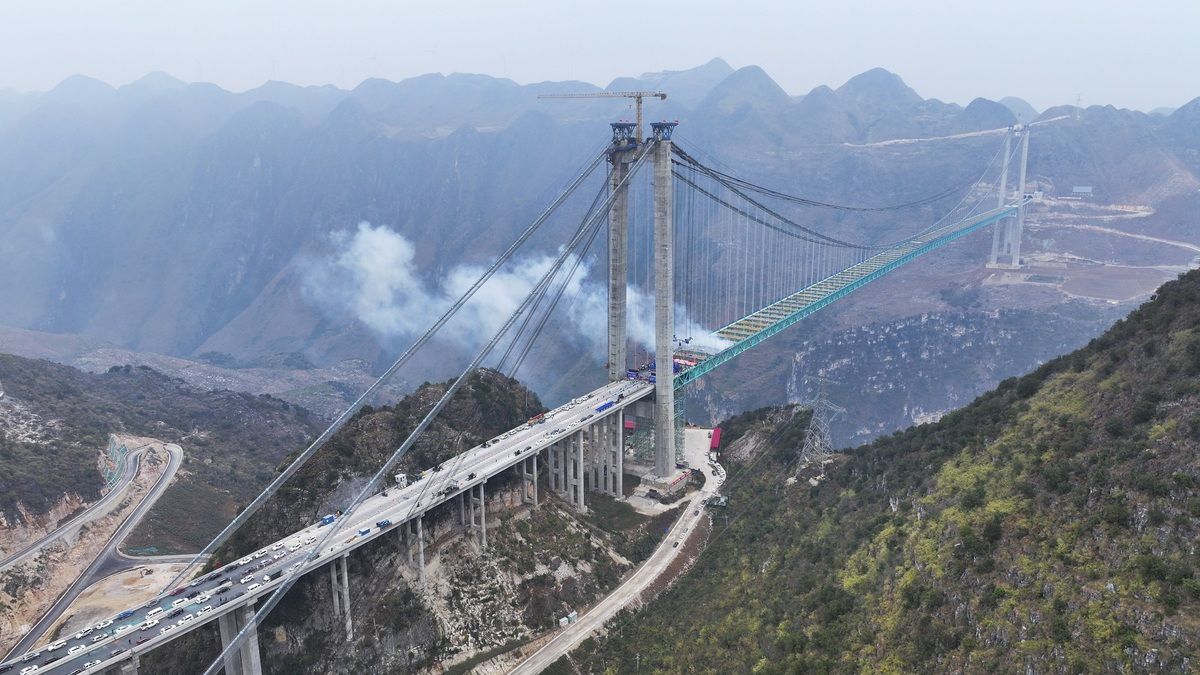
This photo shows a view of the Huajiang Grand Canyon Bridge in Southwest China's Guizhou province, Jan 17, 2025. [Photo by Liu Yelin/for chinadaily.com.cn]
Huajiang Grand Canyon Bridge in Guizhou province reached a major milestone as the final steel truss segment, weighing 215 metric tons, was hoisted into place on Friday.
This marks the closure of the main structure and sets a solid foundation for its planned opening in the latter half of 2025.
Construction began in 2022. Towering 625 meters above the Beipan River, the 1,420-meterlong main bridge nearly matches the height of the Shanghai Tower, the tallest building in China.
Upon completion, it is expected to surpass the province's Beipanjiang Bridge as the world's tallest and set a global record for the longest span of any mountain bridge.
Guizhou's rugged terrain has driven the need for extensive bridge infrastructure to support its traffic network.
As a key component of the Liuzhi-Anlong expressway, the bridge will cut travel time across the canyon from about one hour to two minutes. This improved connectivity is expected to boost local tourism by attracting more visitors to attractions nearby such as the famous Huangguoshu Waterfall.
"The completion of the Huajiang Grand Canyon Bridge will strengthen economic ties between Guiyang, Anshun and Qianxinan, fostering regional economic integration," said Chen Jianlei, deputy director of Guizhou Transport Department.
Expressing his joy, Li Zhao, chief engineer of the project, said, "Witnessing my work become something tangible — watching the bridge grow day by day and finally stand tall above the canyon — gives me a profound sense of achievement and pride."
The steel truss structure, the bridge's primary load-bearing element, consists of 93 segments totaling approximately 22,000 tons — equivalent to the weight of three Eiffel Tower.
However, challenges arose due to the rugged terrain of the Huajiang Canyon and unpredictable weather, including fluctuating winds, humidity and temperatures.
To overcome these obstacles, the team utilized a smart cable crane system developed domestically to complete the hoisting. The system, equipped with the Beidou navigation satellite system, allows for accurate one-click lifting.
"When designated coordinates are entered, the system automatically positions the crane at the specified location, reducing workload for operators. While traditional cable crane operations require eight workers, we cut the number to four," Li said.
Additionally, the entire production process incorporated digital management tools, such as real-time monitoring of raw materials and virtual simulations for component alignment, according to Liang Junyuan, project manager from the southwest division of China Railway Baoji Bridge Group.
The team employed 3D scanning technology and virtual simulations to detect potential component clashes, ensuring precision during construction.
"During on-site assembling, we followed a predetermined sequence, achieving 100 percent accuracy in aligning bolts with their designated holes," Li added.
With 80 percent of main construction complete, the focus will soon shift to installing panel segments between the trusses after the upcoming Chinese New Year, keeping the project on track for its opening this year, according to the project team.
Liu Boqian contributed to this story.
Copyright © 2001-2026 湖北荆楚网络科技股份有限公司 All Rights Reserved
互联网新闻信息许可证 4212025003 -
增值电信业务经营许可证 鄂B2-20231273 -
广播电视节目制作经营许可证(鄂)字第00011号
信息网络传播视听节目许可证 1706144 -
互联网出版许可证 (鄂)字3号 -
营业执照
鄂ICP备 13000573号-1  鄂公网安备 42010602000206号
版权为 荆楚网 www.cnhubei.com 所有 未经同意不得复制或镜像