






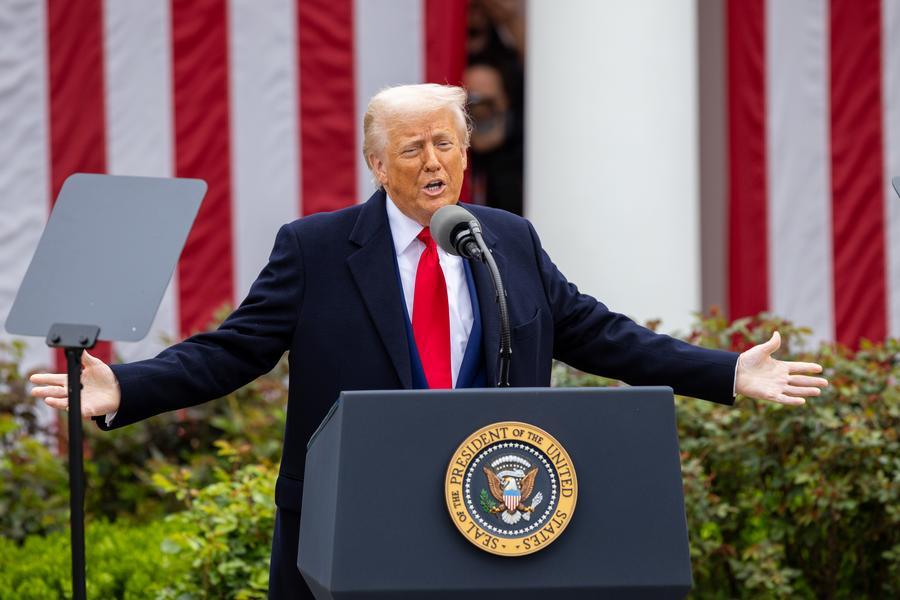
U.S. President Donald Trump delivers remarks on "reciprocal tariffs" at the Rose Garden of the White House in Washington, D.C., the United States, on April 2, 2025.(Xinhua/Hu Yousong)
The international community cannot afford to appease Washington. Restoring the WTO's dispute resolution mechanisms, accelerating institutional reforms and reinforcing multilateral cooperation are crucial to counteracting Washington's unilateral coercion.
BEIJING, April 5 (Xinhua) -- By unilaterally imposing so-called "reciprocal tariffs," Washington has undermined the spirit of the rules-based multilateral trading system and contributed to growing tensions in global trade.
U.S. Treasury Secretary Scott Bessent's six-word warning to the country's trading partners -- "Doing anything rash would be unwise" -- was perhaps the most telling moment of all. It laid bare Washington's enduring belief in its own unchallenged supremacy, a delusion increasingly out of step with a multipolar world.
For the international community, defending the World Trade Organization (WTO)'s authority has become an urgent imperative.
Despite sustained U.S. sabotage, the multilateral trading system remains the backbone of global commerce, overseeing about 98 percent of international merchandise trade. But its survival is far from guaranteed. For years, Washington has worked to undermine the WTO's dispute settlement mechanism, particularly by blocking the appointment of new judges to its appellate court, severely crippling its ability to enforce trade rules.
Restoring the WTO's full functionality is no longer a matter of bureaucratic reform -- it is existential to preserve open and rules-driven global trade.
Washington's latest tariff offensive has landed hardest on nations in the Global South, exposing its deep-seated anxiety over a world shifting toward multipolarity.
Washington has long justified its economic dominance under the guise of global leadership. But as emerging economies strengthen, Washington's control over the global economic order is weakening. Instead of adapting to this new reality, it has chosen to lash out, erecting barriers in a desperate bid to maintain its fading influence.
The irony is that global trade was never designed to be a zero-sum game. From the inception of the multilateral system, its structure accommodated development gaps, allowing emerging economies to use higher tariffs to nurture industries, while advanced economies would benefit from lower trade barriers that promote efficiency and competition.
Washington once championed this system, recognizing that sustainable global growth ultimately benefited all. Now, in its pursuit of unchecked hegemony, Washington appears willing to tear it all down.
Even traditional allies haven't been spared. The EU, Japan and South Korea now find themselves squarely in the crosshairs of so-called "reciprocal tariffs."
The message from Washington is clear: alliances are transactional, and loyalty offers no immunity from economic aggression.
The international community cannot afford to appease Washington. Restoring the WTO's dispute resolution mechanisms, accelerating institutional reforms and reinforcing multilateral cooperation are crucial to counteracting Washington's unilateral coercion.
Only through solidarity can the world push back against the wrecking ball of so-called "American exceptionalism" and safeguard a system that has underpinned decades of global prosperity.
Copyright © 2001-2026 湖北荆楚网络科技股份有限公司 All Rights Reserved
互联网新闻信息许可证 4212025003 -
增值电信业务经营许可证 鄂B2-20231273 -
广播电视节目制作经营许可证(鄂)字第00011号
信息网络传播视听节目许可证 1706144 -
互联网出版许可证 (鄂)字3号 -
营业执照
鄂ICP备 13000573号-1  鄂公网安备 42010602000206号
版权为 荆楚网 www.cnhubei.com 所有 未经同意不得复制或镜像