






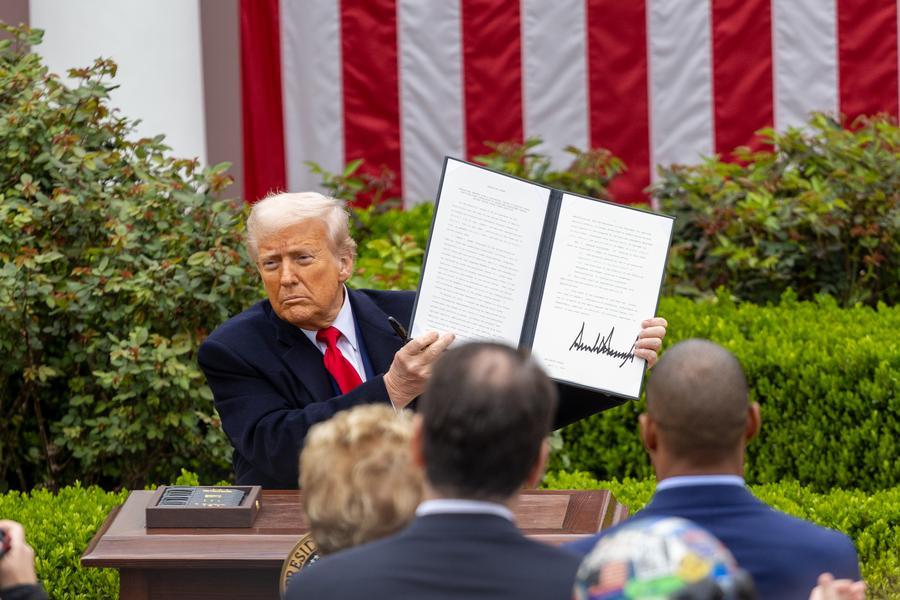
U.S. President Donald Trump shows an executive order on "reciprocal tariffs" at the Rose Garden of the White House in Washington, D.C., the United States, on April 2, 2025. (Xinhua/Hu Yousong)
The U.S. attempt to strong-arm China is like punching a steel wall -- it won't make a dent.
BEIJING, April 11 (Xinhua) -- The U.S. government has taken a dangerous step in recent days with its trade policy, using the rhetoric of "reciprocity" to impose a new wave of tariffs on major global trading partners, particularly China.
In the face of escalating "tariff extortion," China has responded with necessary countermeasures to safeguard its sovereignty, security and development interests.
By imposing the so-called "reciprocal tariffs," the United States has cast aside World Trade Organization (WTO) rules, undermined the legitimate rights and interests of WTO members, damaged the rules-based multilateral trading system, and injected further instability into an already fragile global economic order. At its core, this strategy embraces unilateralism, protectionism, and economic bullying.
Christine Lagarde, president of the European Central Bank, warned that the ripple effects of such policies could endanger global economic stability.
By discriminating among trading partners and unilaterally hiking duties beyond agreed limits, the United States has violated WTO rules, said Chad Bown, a senior fellow at the Peterson Institute for International Economics.
China has made its position unequivocal: "We do not provoke trouble, nor are we intimidated by it. Applying pressure and threats is not the right way to deal with China."
China is fully confident, capable and resilient to deal with this tariff war.
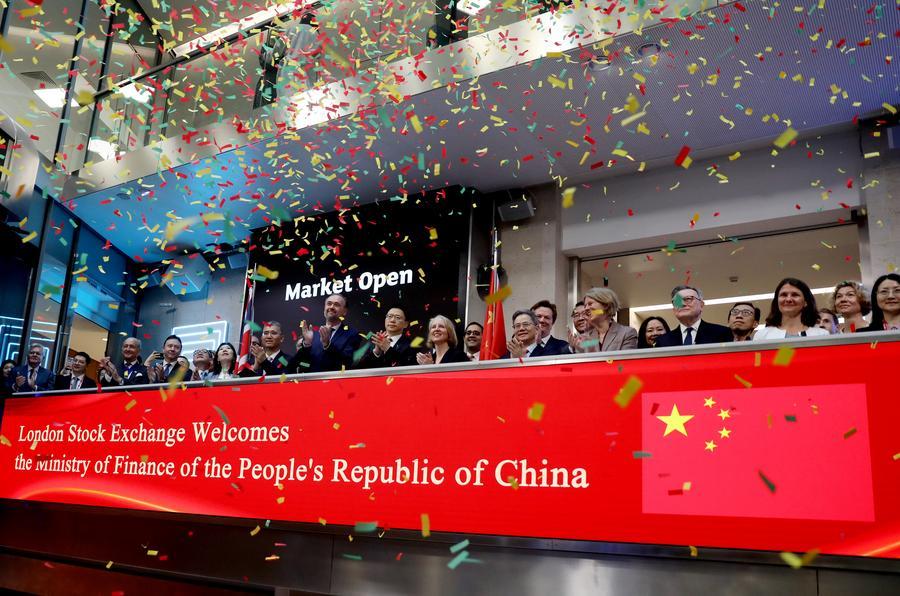
A ceremony is held at the London Stock Exchange to mark the issuance of China's first-ever overseas RMB-denominated sovereign green bond in London, Britain, April 3, 2025. (Xinhua/Li Ying)
Over recent years, China has decreased its reliance on exports to the United States, diversified trade ties with emerging economies, and implemented more flexible policies to strengthen its ability to withstand external disruptions.
China's economic fundamentals remain robust. In 2024, its GDP reached 134.9 trillion yuan (18.9 trillion U.S. dollars), with a growth rate of 5 percent -- a performance that stands out among major global economies.
China's comprehensive industrial capacity -- unique in its inclusion of all manufacturing categories recognized by the United Nations -- provides critical ballast against trade coercion.
China's enormous domestic market of over 1.4 billion people offers strategic depth in weathering external disruptions. Meanwhile, China is committed to a high-level opening-up and continues to cultivate a dense web of mutually beneficial trade partnerships.
With its institutional advantages, economic resilience and strategic wisdom, China has demonstrated to the world its determination to uphold justice and its commitment to resist bullying. The U.S. attempt to strong-arm China is like punching a steel wall -- it won't make a dent.
Washington's turn toward economic unilateralism threatens bilateral ties and the painstakingly built global trade architecture after World War II.
The world must unite against economic bullying. To borrow an old Chinese proverb, "You do not placate a tiger by feeding it your own flesh."
Openness, inclusivity and mutual benefit are the only paths forward. China remains steadfast in defending these principles and ensuring its development contributes to global stability and growth.
Copyright © 2001-2026 湖北荆楚网络科技股份有限公司 All Rights Reserved
互联网新闻信息许可证 4212025003 -
增值电信业务经营许可证 鄂B2-20231273 -
广播电视节目制作经营许可证(鄂)字第00011号
信息网络传播视听节目许可证 1706144 -
互联网出版许可证 (鄂)字3号 -
营业执照
鄂ICP备 13000573号-1  鄂公网安备 42010602000206号
版权为 荆楚网 www.cnhubei.com 所有 未经同意不得复制或镜像