






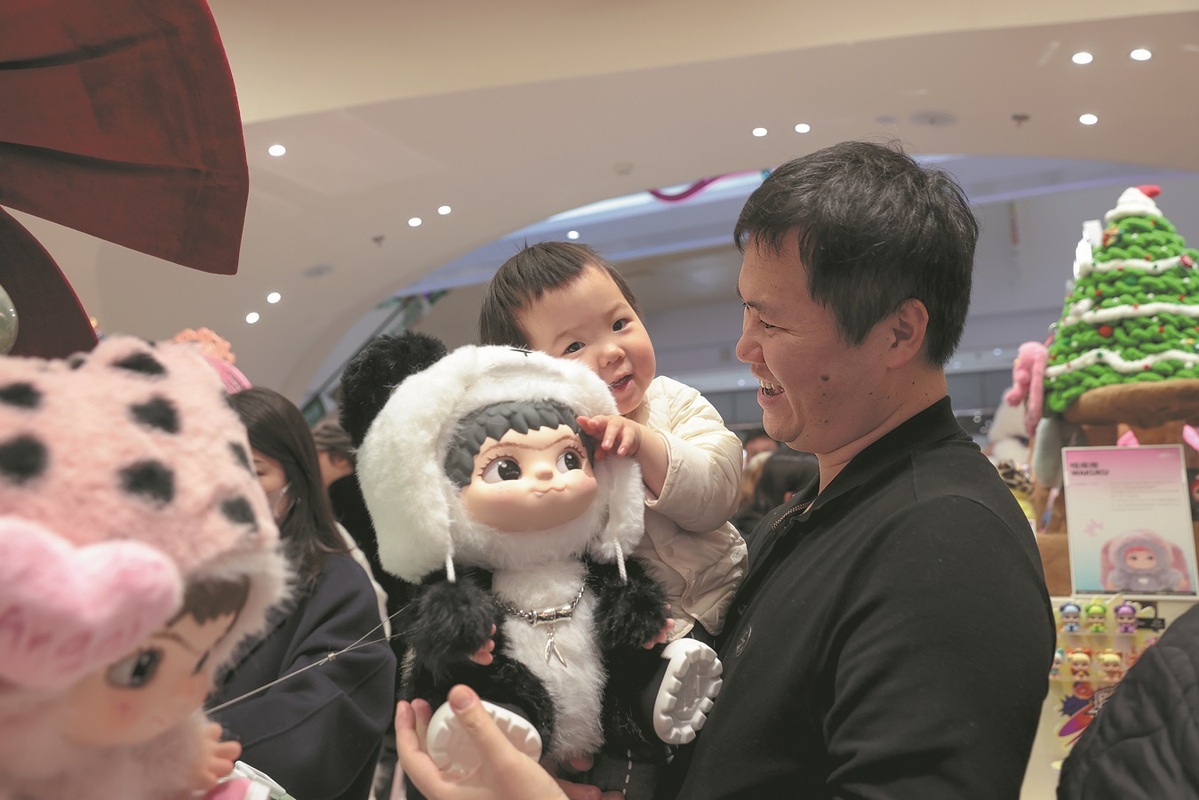
A child hugs a Wakuku, a trendy toy made by Chinese toy producer Here Group, during the opening of the brand's first flagship store in Beijing on Dec 20. Yang Yuran/China News Service
In the world of designer toys, few names stand out right now quite like the Chinese sensation Labubu — a plush toy capturing the imagination of collectors around the globe.
But creating such charming figures is actually a modern science, combining avant-garde ideas and an understanding of culture with technology, artificial intelligence, psychology and a knowledge of market trends.
Take Wakuku, a peer to Labubu, for example. While both are popular "ugly-cute" monster figures, they have very different styles. Unlike Labubu's signature nine pointy teeth and upright ears, Wakuku's look is designed to be more "savage", like a tribal hunter, with a furrowed brow, small fangs and a slanted smirk.
Designed by Chinese studio Here Group, Wakuku is a finely crafted doll, replete with intricate details and big, expressive eyes. Popular in over 20 countries and regions, the figure is sold in blind boxes priced at 69 yuan ($10.05) each.
Its manufacturing process explains why China's designer collectible toy industry is rapidly dominating global trends.
According to Chen Yi, head of product development at Here Group, creating Wakuku requires a balance of creativity, precision and intricate craftsmanship.
"Developing IPs like Wakuku usually takes more than six months," Chen said. "Design and planning alone take about two to three months, prototyping and testing the same, then mass production takes one to two months."
The biggest challenge, though, isn't market testing or production — it's the delicate balance between creative freedom and the strict requirements of industrial manufacturing.
For example, when transitioning designs into 3D models, unexpected challenges arise. "Clothing can interfere with the figure's dynamic posture," Chen said.
To address this, Here Group uses AI simulation tools early in the design process and 3D printing to quickly prototype models, solving issues on the fly.
Here Group is just one of many Chinese toy producers riding the global collectible toy wave. Companies like Pop Mart — home of the beloved Labubu and Molly characters — have evolved from niche art studios into multibillion-dollar businesses. Other players, such as 52toys and Miniso's subsidiary Toptoy, are also capitalizing on the growing demand for collectible figures, expanding their channels and product lines.
According to the "China Trendy Toys and Anime Industry Development Report" by the National Academy of Economic Strategy, the market for such products in China is expected to reach 110.1 billion yuan by 2026, growing at an annual rate of over 20 percent. What truly sets China's industry apart is its ability to blend top-tier intellectual properties with every stage of the production process.
This synergy has helped propel Chinese toy makers onto the global stage, and traditional manufacturing regions like Chenghai in Guangdong province are racing to keep up with demand.
Chenghai, home to over 64,000 toy-related businesses and a workforce of over 300,000, produces more than 600 million toys each year.
Chen Feng, secretary-general of the Chenghai Toy Association, said the industry's transformation began with understanding changing consumer tastes.
"We used to focus on classic toys for children under 15, but now consumers age 15 to 45 are looking for toys with higher quality and more intricate designs," he said.
Last month, Amanda Liu, a Beijing resident in her 40s, purchased a special "Year of the Horse" Dimoo figure from Pop Mart as a bag charm. "It is my New Year luck. Every time I see it, I feel the festive energy," said Liu.
For toy producers, staying engaged with consumers means higher standards of design and production. Chen Feng said that the most meticulous work now goes into details like the eyes, lips and eyebrows of the plastic figures — areas that require a higher level of painting and coloring expertise.
To address this, the association is building a specialized production base, bringing in skilled painters and technicians. "We're not just making toys — we're building brands that can compete on the global stage," he said.
Copyright © 2001-2026 湖北荆楚网络科技股份有限公司 All Rights Reserved
互联网新闻信息许可证 4212025003 -
增值电信业务经营许可证 鄂B2-20231273 -
广播电视节目制作经营许可证(鄂)字第00011号
信息网络传播视听节目许可证 1706144 -
互联网出版许可证 (鄂)字3号 -
营业执照
鄂ICP备 13000573号-1  鄂公网安备 42010602000206号
版权为 荆楚网 www.cnhubei.com 所有 未经同意不得复制或镜像