






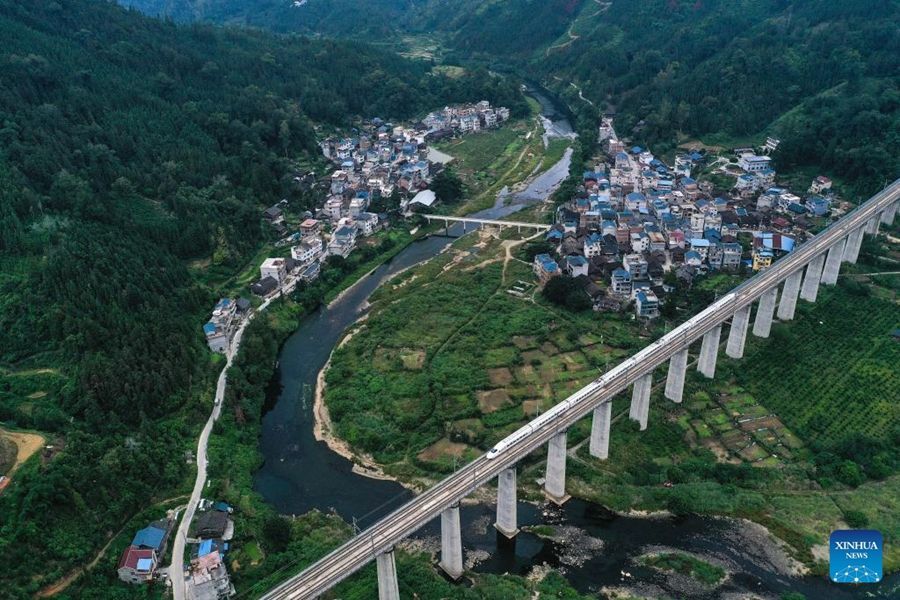
This aerial photo taken on Oct. 10, 2023 shows a bullet train running on a section of the Guiyang-Guangzhou high-speed railway in Congjiang County, southwest China's Guizhou Province. [Photo/Xinhua]
Recently, the UK-based Financial Times published an article titled "China said it ended poverty. Did it?" In this rather long piece, the reporter framed a story around the ridiculous suspicion that China's victory in poverty alleviation is not "sustainable, or even borne out by reality," and the country "is now underestimating the poverty in its midst."
This cunningly crafted article is just another case of selective storytelling frequently used by some Western media to smear and defame China's poverty alleviation efforts and achievements, intended to manipulate and mislead international public opinion.
The playbook sounds all too familiar, as this piece, once again, adopts a sensational headline, using selective examples, incendiary narratives and misleading information rather than providing a balanced, factual account based on rigorous, sufficient data.
By the end of 2020, by a national poverty threshold of 2,300 yuan per person per year at the 2010 price index, all of the 99 million rural poor, as well as the 832 counties and 128,000 villages classified as poor in China, had emerged from poverty, thanks to committed efforts over a span of eight years.
In 2021, China announced that it had eradicated extreme poverty, lifting 770 million people living below the national poverty line out of poverty since the launch of reform and opening up in 1978, accounting for more than 70% of the global total over the same period against the World Bank's international poverty line. China achieved its poverty reduction goal of the U.N. 2030 Agenda for Sustainable Development a decade ahead of schedule, greatly contributing to global poverty reduction and human progress.

An aerial drone photo shows the basketball court of the final match between Kaili City and Yanhe County at the 2026 China's Village Basketball Competition in Taipan Village, Taijiang County, southwest China's Guizhou Province, April 11, 2026. [Photo/Xinhua]
However, the FT reporter deliberately expanded the definition and titled his article "China said it ended poverty. Did it?", instead of using the accurate term "extreme poverty," to set a trap for the readers' assumptions with an arguably impossible ambition, and tried very hard to reinforce an intended answer "No, not really." By framing ending poverty in the title, he can point to any examples and twist the narrative in his favor to "prove" that China has lied.
He then focused on select experiences of a few villagers in Guizhou, one of the poorest provinces in China, with emotional narratives, rather than on large-scale, representative national data, and throughout, made many biased judgements — "China has a relatively low threshold for what constitutes poverty compared with other middle-income countries. And some experts doubt whether one of Beijing's key mechanisms for improving living standards — the relocation of millions of rural residents from their remote villages to urban housing — has achieved what was intended"; "That static definition [of poverty] means that China's poverty measures fail to account for people not on the original list who have since slipped into poverty due to personal circumstances or subsequent shocks"; and "Beijing's intense pride at having eradicated poverty is impeding its efforts to confront it."
The fact is that China adopts a holistic approach to measuring poverty across multiple dimensions, including education, healthcare, housing and other welfare, rather than just income thresholds. In the final stage of fighting extreme poverty, impoverished people were registered and deregistered by household. The criteria encompass personal incomes, and the household's situation under the "Two Assurances and Three Guarantees." The income threshold requires that the annual average per capita income for a household remains steady above China's current poverty line, and it was adjusted annually from 2,300 yuan in 2011 to around 4,000 yuan in 2020. The "Two Assurances and Three Guarantees" refers to assurances of adequate food and clothing, and guarantees access to compulsory education, basic medical services and safe housing. Safe drinking water was later included. Statistics show that per capita net income of registered poor households in the country reached 10,740 yuan at the end of 2020, much higher than the international extreme poverty line.
It is evident that this multidimensional framework takes into account not only income, but the realization of impoverished people's rights to subsistence and development. Such standards, on the whole, are higher than the World Bank's definition of extreme poverty, as China has reiterated on various occasions. These standards reflect the realities of China's socioeconomic development, and the basic requirements for achieving moderate prosperity in all respects.

An aerial drone photo taken on July 24, 2021 shows a view of a relocation site for poverty alleviation in Huawu Village of Xinren Miao Township, Qianxi City, southwest China's Guizhou Province. [Photo/Xinhua]
So, did China end its poverty reduction efforts after the eradication of extreme poverty in 2020? The answer is a resounding "No."
The country is fully aware that more should be done to prevent people from slipping back into poverty, address uneven and insufficient development, narrow regional and urban-rural disparities, and improve access to essential public services, so as to enable the realization of common prosperity for all. It set a five-year transitional period from 2021 to 2025 for counties that have shaken off poverty to consolidate and expand poverty alleviation achievements, amid its efforts to advance all-around rural revitalization, a key national strategy aimed to realize the basic modernization of agriculture and rural areas by 2035, and the grand goal of ensuring strong agriculture, a beautiful countryside and well-off farmers by 2050.
Throughout this transitional period, China has continued its empowerment-led efforts in tackling poverty with holistic, systematic policies for long-term sustainability, and firmly upheld the baseline of preventing any large-scale lapse or relapse into poverty. From 2021 to 2025, growth of per capita disposable income of rural residents in counties that have emerged from poverty consistently outpaced the national average in rural areas for five consecutive years. The annual statistical communique data shows that the per capita disposable income of China's rural households in 2025 was 24,456 yuan, up 5.8% from 2024, or 6% in real terms after deducting price factors, and the per capita disposable income of rural households from counties lifted out of poverty was 18,627 yuan, up 6.3%, or a real growth of 6.5%.
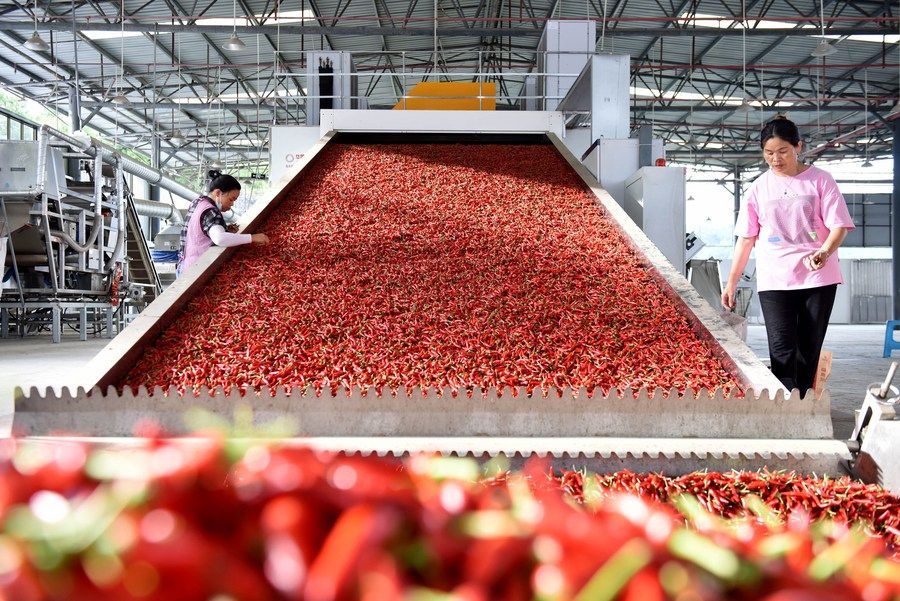
Workers work at a chili peppers processing factory in Wantanhe Township, Longli County, southwest China's Guizhou Province, Aug. 11, 2022. [Photo/Xinhua]
Data from the Ministry of Agriculture and Rural Affairs shows that, by the end of 2025, China had identified and assisted more than 7 million individuals through its monitoring system, effectively eliminating their risk of lapsing or relapsing into poverty. Steady progress has been made in securing access to education, healthcare, safe housing and clean drinking water for formerly impoverished people.
Over the past five years, China has been boosting local industries and jobs, and provided vocational training to enhance development-based, self-sustaining capabilities, while social assistance provides a cushion for those most in need. So far, all 832 counties that have bid farewell to poverty have fostered two to three leading industries with distinctive strengths and strong driving force, with an aggregate output value exceeding 1.7 trillion yuan, and more than 85% of once impoverished households and monitored households have benefited from industry support. The number of employed people among those lifted out of poverty surpassed 32 million in 2025, remaining steadily above 30 million for five consecutive years.
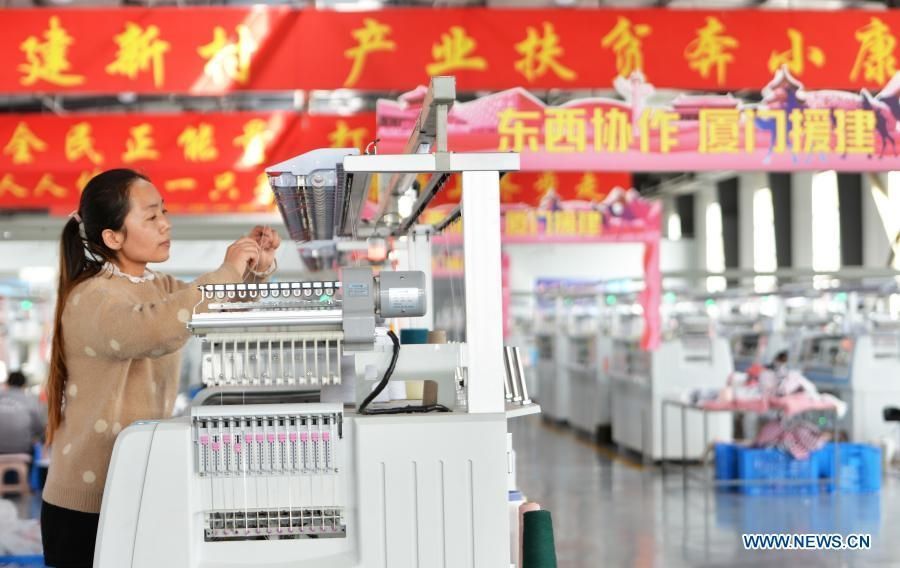
A worker is seen busy on the production line at a poverty-relief workshop aided by Xiamen City of southeast China's Fujian Province in Liujiaxia Town of Yongjing County, northwest China's Gansu Province, Oct. 31, 2020. [Photo/Xinhua]
During this five-year period, Chinese provincial regions carried out dynamic monitoring on households that were prone to or at risk of returning to poverty, including those whose basic living standards were greatly affected due to illness, disability, disasters, accidents or other unforeseen factors, with a baseline set at 1.5 times the national poverty standard in 2020. In addition, adequate annual adjustments were made with three major factors taken into account — consumer price index, growth in per capita disposable income of rural residents, and the rise in the rural subsistence allowance standard. Even in Guizhou, the province with the largest number of people lifted out of poverty and the largest number of people relocated during the battle against poverty, the monitoring line has risen from 6,320 yuan in 2021 to 8,500 yuan in 2025 for rural households in terms of annual average per capita net income to prevent lapse or relapse into poverty.
And it should be noted again that income is an important, but not the only standard for assessing whether a household should be covered by the monitoring system, as access to healthcare, education, safe housing and clean drinking water, as well as relevant sudden factors are all taken into full consideration.
Guizhou has continuously consolidated and expanded its poverty alleviation gains with various policies and measures adopted to help develop local industries, county economies, infrastructure, residential environment and public services to build a solid foundation for self-reliance. In 2024, the per capita disposable income of rural residents in Guizhou's counties lifted out of poverty reached 17,522 yuan, a 24.7% increase compared to 2021; 99% of population lifted out of poverty and those under monitoring participated in the basic medical insurance scheme; and a total of 3,875 compulsory education schools had been newly built or renovated and the retention rate of nine-year compulsory education hit 96% by the end of 2025. Meanwhile, in 2025 alone, 277 million yuan of government subsidies was allocated for the renovation of 5,031 dilapidated rural houses and the seismic retrofitting of 5,196 rural houses; and 95.15% of rural residents have gained access to tap water. The per capita net income of the poor residents relocated from geographically isolated or environmentally inhospitable areas to new, better-resourced locations increased from 11,228 yuan in 2020 to 16,927 yuan in 2024, a growth of 50.76%, representing an average annual increase of over 10%. The employment rate of relocated formerly impoverished labor force in the province reached 96.2%, with an average of 2.4 employed persons per household.

Wang Daiyu (L) of Miao ethnic group and her mother Yang Wenmei show photos of their houses before and after the relocation at the relocation site for poverty-stricken people in Huawu Village, Qianxi County of Bijie City, southwest China's Guizhou Province, Feb. 20, 2021. [Photo/Xinhua]
China's poverty alleviation approach is people-centered with a long-term sustainable mechanism backed by supportive policies, industrial development, infrastructure improvements, strong rural e-commerce, ecological conservation and social security net to spur the internal growth momentum of local areas and promote the rural poor's self-development capabilities. The regular assistance programs are carried out with east-west collaboration, targeted support, paired assistance by central government departments, village-embedded assistance initiatives, and buy-to-support schemes.
As China moves forward, more regular, targeted assistance programs will be implemented to achieve rural revitalization and common prosperity.
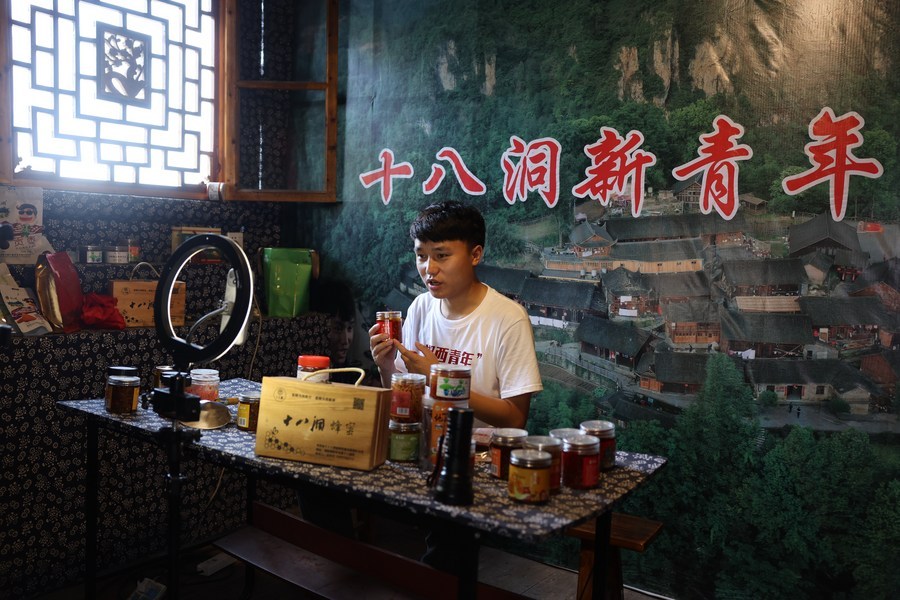
Shi Kang promotes village produce on a livestream in Shibadong Village in Xiangxi Tujia and Miao Autonomous Prefecture, central China's Hunan Province, July 2, 2022. [Photo/Xinhua]
When launching the Global Principles for Information Integrity in 2024, U.N. Secretary-General Antonio Guterres said, "False narratives, distortions and lies breed cynicism, disbelief and disengagement. They undermine social cohesion, putting the Sustainable Development Goals further out of reach."
A healthy international information ecosystem must be built on accurate, consistent and impartial information, with objectivity being the bottom line of news reporting. The despicable acts of using selective narratives or false information to manipulate international public opinion and smear other countries not only violate journalistic professional norms and ethics, but undermine the foundation of mutual trust in the international community and the global poverty reduction cause and inclusive development.
Copyright © 2001-2026 湖北荆楚网络科技股份有限公司 All Rights Reserved
互联网新闻信息许可证 4212025003 -
增值电信业务经营许可证 鄂B2-20231273 -
广播电视节目制作经营许可证(鄂)字第00011号
信息网络传播视听节目许可证 1706144 -
互联网出版许可证 (鄂)字3号 -
营业执照
鄂ICP备 13000573号-1  鄂公网安备 42010602000206号
版权为 荆楚网 www.cnhubei.com 所有 未经同意不得复制或镜像