






(ECNS) -- "Bilateral goods trade total exceeded 1 trillion U.S. dollars for the first time,""The largest trading partner for each other for many consecutive years,""China has introduced visa facilitation measures for several ASEAN countries"...
2026 marks the 35th anniversary of the establishment of China-ASEAN dialogue relations and the theme year of the 5th anniversary of the China-ASEAN Comprehensive Strategic Partnership. Along the way, bilateral cooperation has yielded fruitful results.
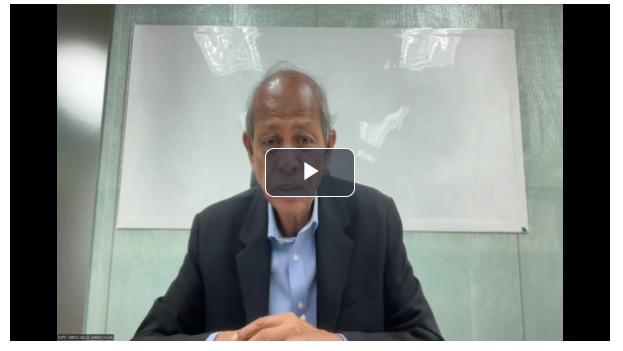
Abdul Majid Ahmad Khan, president of the Malaysia-China Friendship Association and former Malaysian Ambassador to China, has spent nearly half of his career closely tied to China. Nowadays, he remains at the forefront of bilateral exchanges as the head of the Malaysia-China Friendship Association.
In recent years, global unilateralism and protectionism have risen, regional conflicts have occurred frequently, and external uncertainties have increased. How can China-ASEAN cooperation enhance mutual trust, cooperation, and industrial synergy at this new juncture to address global crises?
In this regard, Majid and Xu Liping, a senior researcher at the National Institute of International Strategyof the Chinese Academy of Social Sciences, engaged in a discussion on the latest episode of W.E. Talk hosted by China News Network.
"Bilateral cooperation nearly perfect"
When asked about ASEAN's willingness to cooperate with China amid current trade protectionism and global supply chain restructuring, Majid gave a high score without hesitation.
"I think it's almost eight or nine, almost ten," Majid said with a smile. In his view, despite increasing economic uncertainties and supply chain disruptions, economic cooperation between China and ASEAN has shown remarkable resilience.
Official data support Majid's argument. In 2025, the total trade value between China and ASEAN reached 7.55 trillion yuan, an increase of 8.0 percent year-on-year, achieving growth rather than decline amid external headwinds.
"Despite difficulties on both sides, I think we managed to actually reinforce ourselves to have the resilience and that cooperation keep on floating," Majid explained.
"And that's also keep the bonding of economic cooperation. Good, genuine cooperation to fill the gap of each other. This is the strength of the regional cooperation," he added.
He also specifically mentioned the signing of the Free Trade Area 3.0 Upgrade Protocol, whichin his eyes that the signing of the upgraded protocol is crucial for upgrading the bilateral cooperation platform.
In his view, this clearly demonstrates that "both sides wish to promote regional integration" and marks a leap from scale expansion to quality improvement in bilateral cooperation.
Majid's ideas were agreed by Xu,who said that the great achievements in China-ASEAN economic and trade development are inseparable from the deepening of bilateral cooperation mechanisms. The signing of the "3.0 Protocol" is strong evidence of institutional openness in bilateral cooperation. In the future, the China-ASEAN Comprehensive Strategic Partnership will be further deepened and solidified under institutional safeguards, with the potential to develop into a shared community with a common future.

Xu added that with the further implementation of bilateral free trade agreements and the expansion of zero-tariff trade, both sides can increase cooperation in areas such as agricultural trade, services trade, digital economy, and green economy, cultivating new growth points for bilateral economic and trade cooperation.
"China has its own wisdom and foresight"
The US-Iran tensions since 2026 has had a notable impact on the global energy and economic systems. According to data from the ASEAN Centre for Energy, ASEAN countries rely on the Middle East for 55 percent of their crude oil imports.
Although regional energy security faces challenges, Majid sees this precisely as a key opportunity for deepening cooperation between ASEAN and China.
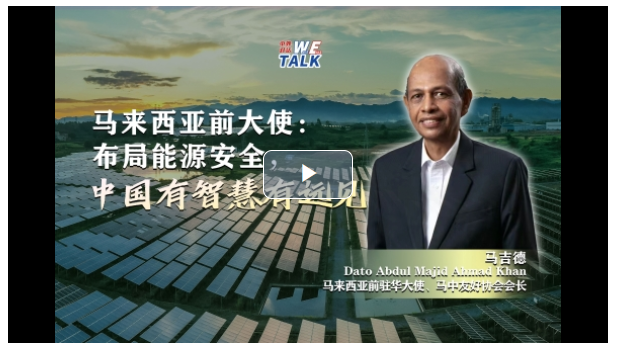
He pointed out that energy demand is a fundamental need for ASEAN countries. Therefore, regional energy connectivity and renewable energy development are becoming meeting points for cooperation between the two sides.
"I think the hot item now is solar. China has it with full wisdom and foreseen this many years ago. China is quite prepared for this."
During the interview, Majid also described a blueprint for cooperation between the two sides in the energy sector. He said that countries with vast territories, such as Indonesia, are very suitable for building different types of solar farms. And China "has the technology, experience, and talent."
Looking ahead to China-ASEAN green development cooperation, Xu said that China has ample personnel, technology, and financial reserves in developing renewable energy, especially in the solar photovoltaic sector. Cooperation between the two sides in this field holds great promise.
In addition to energy security, food security is also a focus of current concern for ASEAN countries. On this point, Xu believes that China can provide more fertilizers and related agricultural technical support. Meanwhile, Majid emphasized supply chain diversification as a "strategic issue."
During the exchange, Majid shared a case that made the concept of "cooperation" tangible.
"We have really developed quite closely with China in the last year on vocational training," he said. In his view, the current training model has moved beyond traditional technical dependence.
"Traditional training might have been nursing, first aid, cooking, or auto repairs," Majid changed his tone, "but now the situation is completely different. We are involved in artificial intelligence, smart manufacturing, and high technology."
He explained that if a country successfully attracts foreign investment but lacks talent with new technical skills, that approach won't work. He pointed out that China has rich experience and skill advantages in these new fields, all of which ASEAN countries need.
"Handle the South China Sea issue like assembling a mobile phone"
The South China Sea issue has always been a highly-discussed topic in China-ASEAN cooperation. When talking about regional cooperation, Majid used the mobile phone assembly process as an example to clarify his viewpoint.
"If you take a mobile phone apart, there are about 200 components. These components may come from thirty or forty countries, and are finally assembled in China or India."
Majid said with a smile that regional cooperation ultimately leads to international outcomes. In his view, the solution to the South China Sea issue also lies in this "assembly wisdom."
"I think ninety-nine percent of China-ASEAN relations are positive, and one percent is about how we manage the South China Sea issue," Majid said candidly.
He believes that both sides do not need to completely resolve all differences; the most important thing is to manage differences well, understand each other, and advance cooperation.
"We have differences,we have this claim, but I think it doesn't really matter, because we have a bigger goal of regional stability," added him.
In the dialogue, Xu also pointed out on the South China Sea issue that according to the consensus reached between China and ASEAN, 2026 is a key juncture for completing negotiations on the "Code of Conduct in the South China Sea" (COC). Whether progress can be made in the COC negotiations should be the result of joint efforts by both sides.

He emphasized that the next step for both sides should be to continue fostering an atmosphere of friendly consultation and implement the Declaration on the Conduct of Parties in the South China Sea (DOC).
In addition, all parties should not take measures that complicate or internationalize the issue. At the same time, China and ASEAN should jointly follow the established roadmap, step by step, to promote the final conclusion of the COC.
"Peace and stability in the South China Sea serve the interests of China and all ASEAN parties—this is the greatest common denominator," Xu said.
Copyright © 2001-2026 湖北荆楚网络科技股份有限公司 All Rights Reserved
互联网新闻信息许可证 4212025003 -
增值电信业务经营许可证 鄂B2-20231273 -
广播电视节目制作经营许可证(鄂)字第00011号
信息网络传播视听节目许可证 1706144 -
互联网出版许可证 (鄂)字3号 -
营业执照
鄂ICP备 13000573号-1  鄂公网安备 42010602000206号
版权为 荆楚网 www.cnhubei.com 所有 未经同意不得复制或镜像