






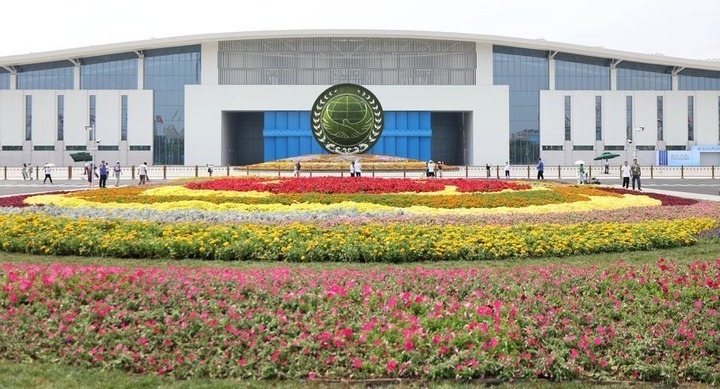
This photo taken on Aug. 29, 2025 shows an exterior view of the main venue of the Shanghai Cooperation Organization (SCO) Summit 2025 in north China's Tianjin. (Xinhua/Yang Qing)
y Al Mamun Harun Ur Rashid
As the Shanghai Cooperation Organization (SCO) enters its 25th year, the international system stands at an important historical crossroads, marked by escalating geopolitical tensions and zero-sum thinking. While Western countries erect exclusive blocs to deter the Global South and preserve their superpower dominance, China actively advances the SCO, not a military alliance, but a platform of partnership and mutual cooperation to build a community with a shared future for humanity.
Established in Shanghai on June 15, 2001, by China, Russia, Kazakhstan, Kyrgyzstan, Tajikistan and Uzbekistan, the SCO evolved from the Shanghai Five mechanism. India and Pakistan joined in 2017, Iran in 2023 and Belarus in 2024, bringing its full membership to 10 countries.
What began as a Central Asian security mechanism now spans Eurasia, covering security, trade, transport, energy, agriculture, science, education, health and culture. It is neither a military alliance nor an economic bloc, but a platform for cooperation among states with mutually diverse interests and foreign policies.
This expansion reflects the magnetic appeal of the "Shanghai Spirit," which rejects exclusive alliances to practice "harmony without uniformity." It provides an institutional space where diverse nations cooperate on an equal footing while fully preserving their strategic autonomy and distinctive development paths.
The China-proposed Belt and Road Initiative (BRI) has also become an important element of economic discussions within the organization. Several SCO members have supported efforts to connect BRI projects with other regional economic initiatives, including the Eurasian Economic Union. It is estimated that the combined economic aggregate of the SCO member states stands at close to 30 trillion U.S. dollars.
Countries across Asia, Africa, Latin America and the Middle East have increasingly called for greater representation in global decision-making, particularly in institutions whose structures were established under different geopolitical and economic conditions.
At the "Shanghai Cooperation Organization Plus" Meeting on Sept. 1, 2025, Chinese President Xi Jinping emphasized taking actions to uphold international fairness and justice, urging member states to oppose hegemonism and power politics. This stance reinforces the SCO's role as a pillar of global governance reform.
Beyond security, the SCO is developing financial cooperation, including greater use of national currencies and financing mechanisms. The New Development Bank, though a BRICS institution rather than an SCO body, reflects the expanding Global South development finance architecture, with 42.9 billion U.S. dollars approved for 139 projects by the end of 2025.
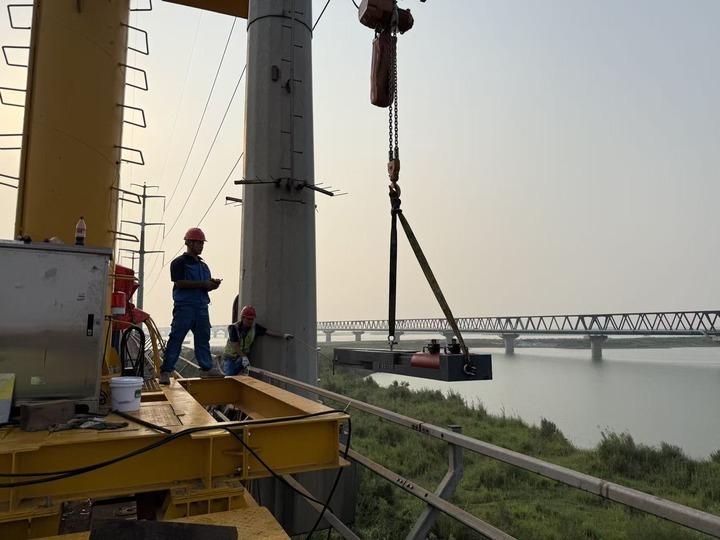
This photo taken on July 11, 2026 shows a view of a repair work construction site by Intelligent Engineering Connections Incorporated (IEC) and its local partners at Jamuna Bridge spanning the Jamuna River in north-central Bangladesh. (Xinhua)
The SCO's expanding network of partner countries also gives non-members channels for engagement on trade, transport, energy, tourism, education and other issues.
For regional countries such as Bangladesh, the SCO's significance can therefore be viewed through the prism of connectivity and economic development.
Bangladesh does not need to choose between competing geopolitical camps to engage with emerging Eurasian institutions. Its interests could include greater access to Central Asian markets, transport connectivity, energy cooperation, food security, digital development and wider South-South economic links.
The 25-year journey of the SCO proves to the world that a more representative and balanced international order is entirely achievable.
The SCO has already demonstrated that countries with respective interests can maintain a common institutional framework. Its next challenge is to translate that political durability into more measurable gains in trade, connectivity, development, security and people-to-people cooperation.
Editor's note: Al Mamun Harun Ur Rashid is a diplomatic correspondent at The New Nation, a leading English-language mainstream newspaper in Bangladesh. He covers Bangladesh's foreign policy, diplomacy, regional affairs and international relations, with a particular focus on China, the broader Asia-Pacific region and the Global South.
The views expressed in this article are those of the author and do not necessarily reflect the positions of Xinhua News Agency.
Copyright © 2001-2026 湖北荆楚网络科技股份有限公司 All Rights Reserved
互联网新闻信息许可证 4212025003 -
增值电信业务经营许可证 鄂B2-20231273 -
广播电视节目制作经营许可证(鄂)字第00011号
信息网络传播视听节目许可证 1706144 -
互联网出版许可证 (鄂)字3号 -
营业执照
鄂ICP备 13000573号-1  鄂公网安备 42010602000206号
版权为 荆楚网 www.cnhubei.com 所有 未经同意不得复制或镜像